

The base station stays the same.
The signal route adapts.
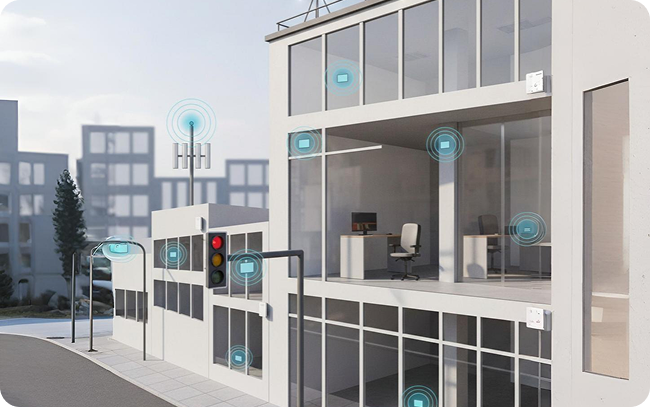
mmWave signals don't bend around obstacles — they stop. V-Mesh forms a coordinated multi-hop propagation path across RF-on-Glass™ repeaters, continuously managed by the Visban Orchestrator as devices move and conditions change.
Built on glass, built to scale. See why
RF-on-Glass is a game changer.

How It Works
mmWave coverage depends on
a continuous line of sight.
The physics are simple: mmWave signals don't bend. Corners, building facades, foliage, and even glass interrupt propagation long before a device reaches its range limit.
Conventional responses create new problems.
Adding base stations multiplies cost. Networks often fall back to slower, congested lower-frequency bands.
We don’t just add hardware; we add intelligence. Visban's repeaters function as a coordinated, network-managed system — continuously adapting the signal path in real time as the environment changes.

The signal path changes while the connection persists.
As devices move and surroundings change, the signal path adapts in real time. The Visban Orchestrator continuously identifies and shifts the signal across the network of repeaters to balance load and minimize interference, so the mmWave connection remains uninterrupted — even during handovers.

The network operates transparently.
V-Mesh is designed to sit within your existing 5G/6G architecture — no rearchitecting or specialized device logic required. Devices connect and hand over between base stations exactly as they normally would, while V-Mesh maintains the underlying signal path without touching the core network.

The intelligence
is predictive, not reactive.
V-Mesh doesn't wait for a signal to drop; it stays ahead of the environment. The Visban Orchestrator analyzes device movement and environmental data to proactively optimize the signal path so the highest-capacity link is ready before conditions degrade.
Continuous outdoor-to-indoor mmWave coverage.
mmWave coverage doesn't stop at the window. V-Mesh extends the signal path into interior spaces through RF-on-Glass repeaters, maintaining full mmWave throughput as users move indoors.
RF-on-Glass™: Built to deploy at scale.
Dense mmWave coverage requires hardware density that traditional manufacturing cannot sustain.
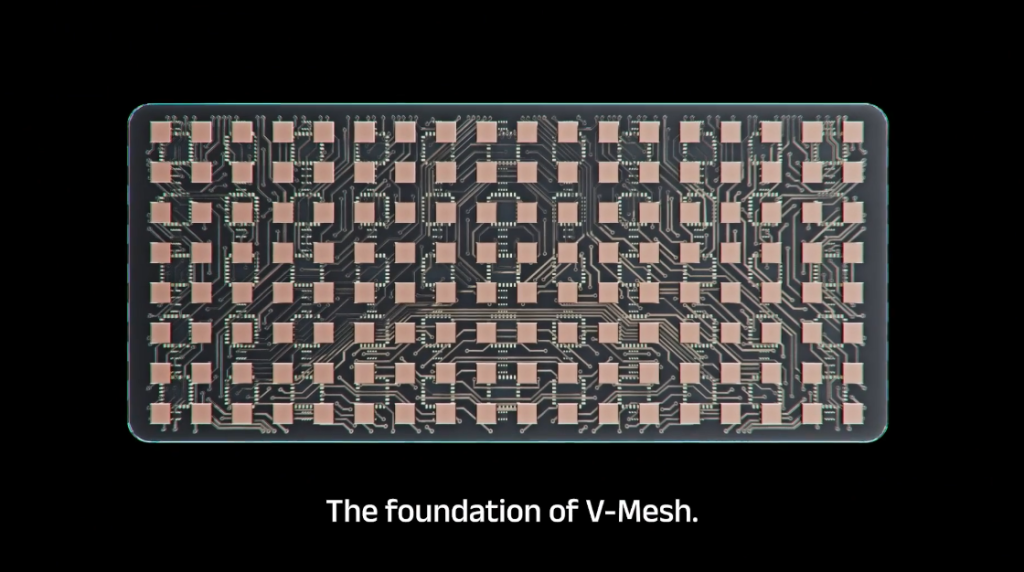
Display-scale manufacturing. Visban repeaters are fabricated on glass substrates using the same high-volume processes that power the global display industry — driving unit costs far below conventional mmWave hardware.
Deployment without the cost barrier. Low per-unit costs make dense V-Mesh deployment viable at scale — operators can place repeaters exactly where coverage is needed without infrastructure economics becoming the constraint.
Become a V-Mesh
Trial Partner
V-Mesh has been field-tested. Soon, we'll be bringing it into live networks to fine-tune performance and collect real-world data. We're selecting a limited number of trial partners — enterprises and private network operators dealing with real mmWave density, NLOS coverage, or in-building continuity challenges. If that's your environment, fill out the form and we'll be in touch.